
Understanding Medicare Parts A & B Changes for 2026
Quick Navigation — Jump to a Section
What’s New for Medicare in 2026?
A Purely Educational Overview of Key 2026 Changes Published by Policy Engineer Insurance Solutions — For Informational Purposes Only At Policy Engineer Insurance Solutions, our goal is to help you understand these changes from an educational standpoint so you can plan with clarity.
What are Parts A and B?
-
Part A (Hospital Insurance): Covers inpatient hospital stays, skilled nursing facility care, hospice, and some home health services.
-
Part B (Medical Insurance): Covers outpatient care, physician services, preventive services, durable medical equipment, and certain other services not covered under Part A
Key Changes for 2026
Part A: Premiums & Deductibles
-
The inpatient hospital deductible for 2026 will be $1,736, up from $1,676 in 2025—an increase of $60.
-
Hospital daily coinsurance amounts:
-
For days 61-90 of a hospitalization benefit period: $434/day (up from $419).
-
For lifetime reserve days: $868/day (up from $838).
-
-
Skilled nursing facility daily coinsurance for days 21-100: $217 (up from $209.50). CMS
-
Part A monthly premium for those who must pay (because they have fewer than the required quarters):
-
Reduced monthly premium (for those with at least 30 but fewer than 40 quarters): $311 in 2026 (up $26).
-
Full premium (fewer than 30 quarters): $565 in 2026 (up $47).
-
Part B: Premiums & Deductibles
-
Standard monthly premium for Part B: $202.90 for 2026, up from $185.00 in 2025 (an increase of $17.90).
-
Annual deductible for Part B: $283 in 2026, up from $257 in 2025 (increase of $26).
-
For individuals with kidney transplants who use immunosuppressive drugs and continue Part B coverage, the premium is $121.60.
Income-Related Monthly Adjustment Amounts (IRMAA)
-
Part B and Part D monthly costs can increase further for high-income beneficiaries based on their modified adjusted gross income
(MAGI). CMS
For example, for full Part B coverage in 2026:Individuals with MAGI ≤ $109,000 (or joint ≤ $218,000): pay standard
monthly costs ($202.90). Individuals with MAGI > $109k ≤
$137k (joint > $218k ≤ $274k): pay an additional $81.20,
making the total monthly costs $284.10.
And for higher income levels: totals rise to $405.80, $527.50, $649.20,depending on MAGI bracket.
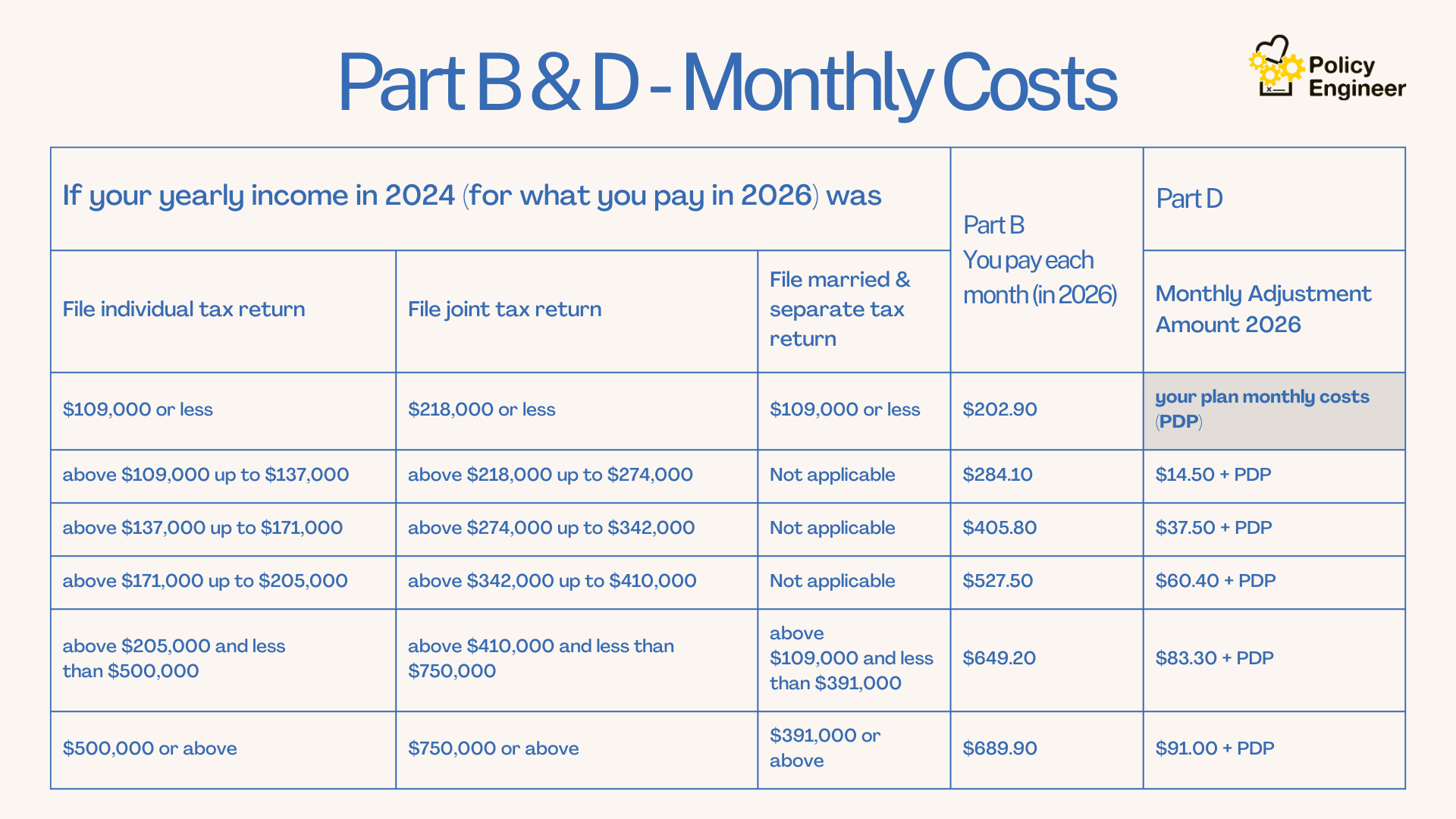
Part B & D – Premium Costs
How Does Medicare Calculate Part B Part D Premiums?
• To determine your Medicare premiums for a specific year, Medicare examines your income from the tax return submitted two years prior.
• This means that for 2026 premiums, your 2024 tax return will be used.
Medicare uses your Modified Adjusted Gross Income (MAGI) to determine your premiums.
• MAGI includes your Adjusted Gross Income (AGI) and tax-exempt interest income.
• Medicare uses income tiers, which determine your premium based on your MAGI.
• Investment income types used to calculate Medicare premiums include interest, dividends, capital gains, rental income, and tax-exempt interest.
Why These Changes?
According to CMS, the increases reflect:
-
Projected price changes (costs of medical services, hospital stays, etc.). CMS
-
Forecasted utilization increases (beneficiaries using more services or costlier services). CMS
-
For Part B: Without certain policy interventions (e.g., changes to skin substitute spending), the premium would have been about $11 higher/month. CMS
What This Means for You
-
Even modest increases in premiums and deductibles can impact annual healthcare budgeting. If
you’re used to $185/month for Part B, you’ll now plan for $202.90/month (before IRMAA). If you travel, switch plans,or see many specialists, higher cost-sharing (deductibles, coinsurance) may come into play—so evaluate overall cost,
not just the premium. High-income beneficiaries should especially review IRMAA brackets, as cost increases can be sizeable. If you expect heavy utilization (e.g., long hospital stay), increases in hospital deductibles and daily coinsurance for extended stays matter — make sure you understand how far your coverage carries you. Consider revisiting your healthcare coverage decisions, supplemental insurance (Medigap), Medicare Advantage plans, or other out-of-pocket coverage strategies in light of these updated numbers
Action Steps to Take
-
Review your current Medicare coverage: Are you on Original Medicare (Parts A & B)? Are you considering switching to a Medicare Advantage or adding a Medigap policy?
-
Update your healthcare budget: Move from $185 to $202.90 for the standard Part B premium; adjust for potential IRMAA if applicable.
-
Check for supplemental coverage: If you anticipate deductibles or coinsurance will be significant, see whether a Medigap plan or Advantage plan with better cost-sharing makes sense.
-
Be mindful of income changes: If your income has changed significantly (for self-employment, investment income, etc.), you may fall into a different IRMAA bracket.
-
Mark key dates: Typically, Medicare annual enrollment and plan changes coincide with end-of-year windows. Stay alert for communications from CMS and your plan.
-
Ask questions: If you’re unclear about how these changes affect you, reach out to Medicare.gov, your local State Health Insurance Assistance Program (SHIP), or a trusted advisor.
The 2026 updates to Medicare’s monthly costs and deductibles may not represent dramatic shifts, but they are meaningful. An increase of roughly $18/month for Part B and higher deductibles and coinsurance under Part A means that for many beneficiaries, out-of-pocket planning needs to adjust. Coupled with the income-related surcharges, it’s more important than ever to review your Medicare strategyproactively and ensure that your coverage meets your health, financial, and lifestyle needs.


